

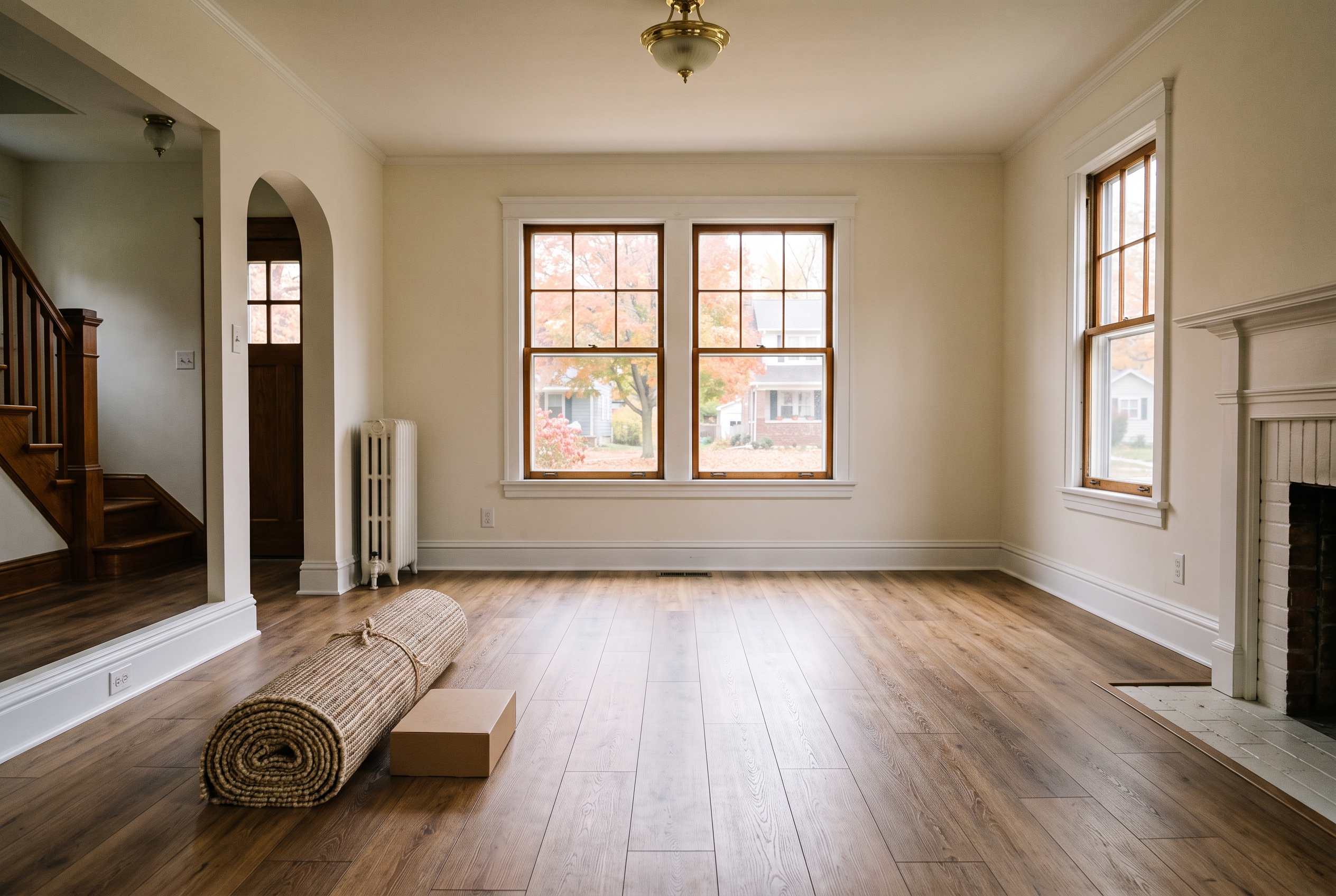
Three things decide it: whether the rental already has hardwood, how hard the next tenants will be on the floor, and how wet each room gets. Laminate survives a rough turnover by resisting scratches, and a damaged plank can come out without redoing the room. Hardwood survives because it can be renewed with a fresh coat of finish or a sanding. In a rental, neither one is our pick for a full bathroom.
Keep the hardwood you already have. Solid wood with sanding left in it is the cheapest premium floor you will ever own. A recoat between tenants costs a fraction of any new floor.
For most rentals that need a new floor, choose laminate. Pick one with a high wear rating and a waterproof rating. It shrugs off nail scratches and chair scuffs and resets between tenants in a day, which matters most with pets, students or short leases.
New hardwood pays in a house you will hold for years. It fits a single-family rental near the top of your market, one with long leases, or one you may sell or move back into.
Water decides the kitchen, bath, laundry and basement. Waterproof-rated laminate handles a rental kitchen. Full baths, laundry rooms and any basement level with a sump pump or floor drain get luxury vinyl or tile.
Upstairs, the underlayment matters more than the floor. Either floor works over a pad rated for impact sound, and the tenant below will notice the difference.
If a tenant just left the floor damaged, it is usually a repair. Most scratches, swollen planks and stained boards are fixed plank by plank or board by board. The whole room rarely has to go.
| Your rental | Our pick | Why it survives turnover |
|---|---|---|
| Solid hardwood already in place | Keep it; recoat between tenants | The finish renews; the wood lasts |
| Hardwood under old carpet | Uncover and refinish if it can be sanded | Costs less than any new floor |
| Replacing worn carpet, most rentals | Rental-grade laminate | Resists scratches; damaged planks swap out |
| Pets, students or yearly turnover | Rental-grade laminate, AC4 | Resets in a day between leases |
| Long hold, single-family, may sell | Engineered or solid hardwood | Refinished rather than replaced |
| Kitchen | Waterproof-rated laminate | Handles spills that get wiped up |
| Full bath, laundry, sump-pump basement | Luxury vinyl or tile | Standing water cannot hurt it |
| Upstairs unit over another tenant | Either, on sound-rated underlayment | Fewer footstep complaints from below |
How Hardwood and Laminate Wear Between Tenants
Laminate survives more tenancies without work, and hardwood survives more decades with work. The reason is that they wear out in different layers. Hardwood wears first in its clear finish, and it dents because wood is softer than it looks. Laminate's printed surface is harder and resists scratches, but once that surface or a plank's core is damaged, the only fix is a new plank.
Walk a hardwood floor the day the keys come back and you will usually see dull traffic lanes from the door to the kitchen. You will see fine scratches where chairs slid and dogs turned, and a few dents where something heavy landed. Most of that sits in the finish, and a new coat takes it away. Dents and deep gouges go into the wood itself, and those need sanding or a new board.
A laminate floor after the same tenancy often looks close to move-in day across the open floor. Its wear layer is built for foot traffic and furniture. Where laminate shows a hard year is at the edges, such as a chipped plank end at a doorway or a seam that swelled beside the sink. A lifted edge where a refrigerator line dripped is another. Scuffs clean off with a damp mop, and a swollen or chipped plank comes out.
The end of life differs too. A solid wood floor that is cared for lasts for generations, since it can be sanded back to fresh wood many times. Its real lifespan is the wood left above the tongue. A laminate floor is finished when its wear layer is gone in the traffic lanes, or when the damage runs wider than your spare planks can patch.
Should You Keep, Refinish or Cover Existing Hardwood in a Rental?
Two things decide it: whether the floor is solid wood, and whether it has sanding left. If both are true, keep it, because nothing you could buy costs less or rents better. Refinish it before the first tenant if the finish is worn to bare wood. Cover it only when it cannot take another sanding, or when the unit's tenants would ruin a new finish every lease.
Plenty of older houses in South Bend and Mishawaka have oak strip flooring under wall-to-wall carpet that went down decades later. A turnover is the natural time to find out. Pull back the carpet in a closet corner first. If there is wood, the carpet, pad, tack strip and staples all come up.
Expect some pad stains, tack-strip holes along the walls and a yellowed finish. A sanding takes care of surface stains and the old finish. Dark stains that go into the wood, often from a pet years ago, do not sand out. We replace those boards with new ones matched to the floor. A floor with a few character marks under a fresh finish still rents as hardwood.
From then on, the goal is to keep the finish intact. An intact finish can be recoated between tenants rather than sanded, and that is the difference between a turnover measured in days and one measured in weeks. If the finish on a floor you are about to rent out is merely dull, recoat it before the first tenant so their wear lands in fresh finish.
How to Tell Whether Old Hardwood Can Be Sanded Again
Old hardwood can be sanded again when enough wood is left above the tongue, and you can usually check that without tools. The National Wood Flooring Association's guideline is that a floor with less than about 3/32 inch of wear layer left should not be sanded. That is a little under 1/8 inch, about the thickness of three credit cards stacked.
- Lift a floor register cover and look at the cut edge of the boards. On solid strip flooring you will see the wood above the tongue, and a healthy band means there is sanding left.
- Look for nail heads showing on the surface, or boards with the tongue visible at the edges. Either one means the floor has been sanded as far as it can go.
- Check a threshold or the top of a stair, where the full board profile often shows.
- On an engineered floor, measure the top veneer at a register opening. A veneer under about 3/32 inch can be recoated but not sanded.
- Test for old wax in a closet corner. Rub a little mineral spirits on a white rag, or leave two drops of water for ten minutes. A yellow or brown rag, or white spots under the water, point to wax, and wax has to come off before a modern finish will bond.
Putting Laminate Over Old Hardwood
If the wood is past sanding or badly damaged, laminate can go right over it. Laminate can be installed over existing wood flooring on a wood subfloor, as long as the old floor is flat, dry and firmly fastened. Any squeaks or loose boards get fixed first so they do not show through.
Covering can make sense even for good wood. A floating laminate floor is never nailed or glued down, because it rests on the old boards. That means it can come up later and leave the hardwood for a future sale or for the year you move back in.
Covering does have practical costs. Because the floor rises by the laminate's thickness, doors may need trimming and thresholds need transitions. And while the wood is covered, you give up its appeal in the listing photos.
Is New Hardwood Worth Installing in a Rental?
New hardwood is worth it in fewer rentals than it seems. What decides it is the cost of each turnover, more than whether wood is durable. It pays in a single-family house you will hold for years or rent near the top of your market. It also pays where tenants stay for several leases, or where you may sell or move back in. It rarely pays in a unit with pets, students or yearly leases.
Over a long hold, wood earns its place because the floor never has to be replaced. Every few tenancies it gets a new coat of finish, and every decade or two a sanding. Meanwhile the house keeps the appeal wood floors carry in a listing.
Put the same floor in a unit that turns over every summer and the math changes. It needs recoating far more often, and it is more likely to collect pet stains and gouges that need new boards. Those costs and empty days add up faster than any rent premium you can charge. If the floor is for a home you live in, the calculation is different. Our comparison of laminate and hardwood for your own home walks through it.
If you do choose wood, choose it for tenants. A prefinished floor can be walked on the day it goes down, which matters when the next lease starts on a set date. Browse the hardwood we carry with that in mind. On stairs, hardwood treads wear first at the front edge and are slippery in socks. A runner or carpet on the stairs protects both the wood and the tenant.
Solid or Engineered Hardwood for a Rental
For a rental, the wear layer decides between solid and engineered hardwood. An engineered floor with a thick top layer of real wood can be sanded and refinished. It also moves less through a dry winter and can go below grade or over a concrete slab. An engineered floor with a thin top layer can take new coats of finish but no sanding, which makes it a one-finish floor.
Solid hardwood has the most sandings in it and belongs on or above grade, over a wood subfloor. Engineered hardwood with a wear layer of about 3/32 inch or more can still be sanded and refinished. It is the only real wood that suits a basement unit on a dry slab.
Ask for the wear layer thickness on the spec sheet before you compare prices. Two engineered floors that look alike on a sample board can differ by several refinishes. Our page on solid and engineered hardwood shows how each is built. Many prefinished floors carry a hard factory finish that wears well, and it is recoated by the flooring maker's own procedure.
Species, Color and Sheen That Hide Tenant Wear
Hardness, color and shine together decide how much tenant wear shows. Oak, maple and hickory resist dents better than walnut, cherry or birch. A mid-tone floor with visible grain hides dust, pet hair and fine scratches. A very dark or very light floor shows them from across the room.
Sheen matters as much as species. The less shine a finish has, the less you notice small scratches, so matte and satin beat semi-gloss and gloss in a rental. Wire-brushed and hand-scraped textures hide scratches in the grain as well. Our guide to the best hardwood species for the Michiana climate ranks species by hardness. The same logic applies to laminate, where a textured, low-gloss, mid-tone plank hides what a smooth, shiny one shows.
What Makes Laminate Rental-Grade
If you are shopping laminate for a rental, four specs on the carton or spec sheet matter most. They are the wear rating, the water rating, how the plank is built and how the surface looks up close. Get those right and add a couple of spare cartons, and the floor turns over between tenants with little more than a mop.
| Spec | Ask for in a rental | Why it matters at turnover |
|---|---|---|
| Wear rating (AC) | AC4, or AC3 at least | Traffic lanes stay intact longer |
| Water rating | Sold as waterproof, with stated terms | Spills at sinks and bowls don't swell seams |
| Construction | Attached pad; a lock that comes apart | Quieter, and a plank can be replaced |
| Surface | Textured, low gloss, mid-tone | Hides scratches and dust between cleanings |
| Spare cartons | One or two, labeled with the style | Matching planks after the style is gone |
The wear rating, called the AC rating, measures how well the printed surface stands up to foot traffic. AC3 is rated for heavy home use and AC4 for general commercial traffic. In a rental, AC4 is worth the small step up, because turnover and less careful use eat into the margin. The rating says nothing about water, dents or the locking system.
The water rating is where laminate has changed most. Laminate sold as waterproof keeps spills off its surface and seams for the time its maker states. That is a real advantage in a rental kitchen. Its core is still wood-based, though, so the room and the installation still matter. Our article on whether laminate is waterproof decodes the labels on the box.
Construction decides how the floor feels and how it repairs. A thicker plank with an attached pad feels more solid underfoot, and over a wood subfloor it needs no separate underlayment. Among the laminate we carry, Pergo Elements is built with pet scratch protection, stain resistance and an attached pad. That is the combination a rental uses. You can see it with the rest of the laminate we carry, and our page on how laminate is built explains the layers.
The spare cartons may matter most of all. Laminate styles change every few years. Once yours is discontinued, a swollen plank by the dishwasher can mean a new kitchen floor where it could have been a quick repair. Buy one or two extra cartons with the floor and write the style name and the room on them. Store them somewhere dry where the next tenant will not throw them out.
Kitchens, Bathrooms and Basement Units
Rental kitchens, bathrooms and basements need a stricter rule than the same rooms in your own home. You are not there when a supply line starts to drip. Hardwood stays out of full baths, laundry rooms and basements. Laminate sold as waterproof handles a kitchen, where spills get noticed and wiped up. Where water can stand for hours, luxury vinyl or tile is the floor that survives.
In a kitchen, installation details are what make laminate hold up. The expansion space in front of the sink and dishwasher, around the refrigerator and at exterior doors gets filled with silicone. That keeps a slow drip on top of the floor, where it can be wiped up. A rental kitchen with that detail done, and a water alarm under the sink, is a good home for laminate.
A full bathroom or laundry room is harder on laminate. Water around a tub or a washer can sit unnoticed, and a tenant may not mention a running toilet for weeks. Luxury vinyl, with a core that does not absorb water, shrugs that off, and so does tile. Compare the luxury vinyl we carry for the rooms where water is part of daily life.
Basements need one more check before any laminate is ordered. Pergo's installation instructions, including those for its waterproof lines, rule out laminate in a room with a floor drain. They also rule it out anywhere on a floor level that has a sump pump, and many basements in this area have one.
A basement unit with a sump pump gets luxury vinyl or tile. Engineered hardwood can go below grade on a dry slab, but in a rental basement a wet spring usually argues for a floor water cannot hurt.
Most water that ends a rental floor comes from a handful of sources. They are the dishwasher, the refrigerator's ice-maker line, the toilet supply, the water heater and the washing machine hoses. Braided steel supply lines, a drain pan under the water heater and battery water alarms at each spot cost little next to a floor. Add a lease clause that asks tenants to report leaks within a day, and most leaks end as a plank swap.
Rentals With Pets, Students or Neighbors Below
The tenancy often decides more than the room does. A floor that lasts years under a quiet couple may not last one lease under a big dog or four students. Match the floor to the tenants you rent to.
Rentals Where Dogs and Cats Are Allowed
With pets allowed, laminate with a high wear rating and a waterproof rating is the stronger floor. A dog's nails mark a hardwood finish within months. Those marks mostly sit in the finish, where a recoat takes them out, but a good laminate wear layer resists them from the start.
Accidents worry us more than nails, because urine that sits damages wood and swells laminate seams. A waterproof-rated laminate buys time for cleanup. Put a washable mat under food and water bowls, and charge a pet deposit or fee where your lease allows it. Ask tenants in the lease to clean up accidents right away.
Student Rentals With a Summer Turnover
Houses rented to students near Notre Dame, IU South Bend, Saint Mary's, Holy Cross and Bethel usually turn over every summer. The floor has to be reset inside one short window every year. Laminate with an AC4 rating and spare cartons resets in a day. Existing hardwood can carry a student house if you recoat it every summer or two, before scratches reach the wood.
New hardwood rarely makes sense in a student house, because the recoats come every year and so do gouges from moved furniture. Put felt pads in the move-in kit, since students rearrange furniture more than most tenants. Set mats at every door for the months when grit and road salt come in on boots.
Duplexes and Apartment Buildings
In a duplex or small apartment building, put the same floor in every unit if you can. A spare carton then patches any unit, and you choose the floor once for the whole building. Then think about the tenant downstairs, because an upstairs hard floor is where most noise complaints start.
Replacing carpet with a hard floor upstairs can make footsteps louder below, unless the new floor sits on an underlayment rated for impact sound. The building code asks for an impact rating of at least 50 between dwelling units in the buildings it covers. Many condominium associations write their own minimum into their rules, so read the bylaws before you order.
Our guide to quiet wood and laminate floors explains the ratings and the underlayments that meet them. We also do multi-family flooring, so a building's worth of units is familiar work for us.
Furnished and Short-Term Rentals
In a furnished or short-term rental, the guests change and the furniture stays. Dents and scrapes from dragged chairs and luggage wheels matter more than pet scratches. Either floor works with felt pads under every leg, rubber chair casters and rugs where guests drop bags. If the place may become your own home one day, hardwood is the floor you will be glad you chose.
What Each Floor Costs Over the Life of a Rental
Laminate costs less to buy and install, and less at each turnover. Hardwood costs more up front and needs a new coat of finish every few tenancies, but it may never need replacing. Which one is cheaper over the life of a rental depends on how long you hold it and how hard the tenancies are.
For a sense of scale on hardwood, the National Association of Realtors' remodeling study put a typical refinishing project at about $3,400. A typical new wood floor came to about $5,500. Those are whole-project national figures, and your job depends on its square footage. They still show why refinishing wood you already have beats buying any new floor. Laminate costs less than most hardwood for a comparable wood look.
The price of either floor moves with the same things. Square footage leads, followed by how much old flooring has to come up and be hauled away and whether the subfloor needs leveling. Stairs, rooms and transitions add to it. For hardwood, it also matters whether it arrives prefinished or is finished on site.
Those variables are why we price every job at a free in-home estimate, with a written price before anything starts. We also offer financing when a whole unit or building is done at once.
| What you pay for | Laminate | Hardwood |
|---|---|---|
| The floor, installed | Lower | Higher |
| Each turnover | Cleaning; a plank or two | Cleaning; board repairs as needed |
| Every few tenancies | Usually nothing | A recoat and a few empty days |
| End of life | A new floor | A sanding and refinish |
To compare the two for your property, count turnovers rather than years:
- Estimate how many tenants the floor will see before you sell the property or replace the floor.
- For each floor, add up what a typical move-out costs, from cleaning and planks to a recoat.
- Add the rent lost while the unit sits empty for that work, including the days a finish needs to cure.
A long-hold house with long leases usually comes out in favor of hardwood. A unit that turns every year usually favors laminate.
Does Hardwood Raise the Rent or the Sale Price?
Whether you mean the sale or the rent decides the answer. At sale, the same Realtors' study estimated that refinishing hardwood recovered 147 percent of its cost, and new wood flooring 118 percent. Those were the two highest returns among interior projects. For rent, no study with a stated method shows a set premium, so your own market has to answer it.
Look up comparable rentals in your neighborhood, with and without hardwood in the listing, and compare the asking rents and how long each one sat. Laminate photographs as a wood look. Describing it as wood-look laminate in the listing keeps a tenant from feeling misled at the showing.
How Rental Flooring Is Depreciated
IRS Publication 527 lists flooring among its examples of improvements, which are capitalized and depreciated over time. The publication treats carpet as 5-year property. A new hard floor, as an improvement to the building, takes the building's 27.5-year schedule. Fixing a few damaged planks or boards is the kind of repair the publication says you can generally deduct in the year you pay for it.
The publication also describes safe harbors that can change how a smaller job is treated, and your tax preparer makes the call. Keep invoices that separate repair work from new floors, because that split is what they will ask for.
Resetting the Floor Between Tenants
Walk the floor the day the keys come back, grade what you see, and book any work before you list the unit. Your move-in photos or checklist show what is new. The grade tells you whether the floor needs a cleaning, a repair, a new coat of finish or more.
| Floor and condition | Reset | Days before move-in |
|---|---|---|
| Laminate, scuffed | Deep clean | Same day |
| Laminate, a few damaged planks | Swap planks from spare cartons | Same day or next |
| Hardwood, dull with light scratches | Clean and recoat | About three with a fast finish |
| Hardwood, worn to bare wood or stained | Sand and refinish | Several, plus cure time |
| Either, damaged across the room | Replace the floor | Depends on the order and install |
When to Recoat or Refinish Rental Hardwood
Recoat rental hardwood when the finish is dull and scratched but no scratch reaches bare wood. Sand and refinish only when wear, stains or deep damage have gone into the wood. When the finish is still intact and clean-looking, a cleaning is enough.
A recoat, often called a maintenance coat or a screen and recoat, cleans the old finish, lightly abrades it and adds a fresh coat. It never sands into the wood. It is the reset that makes hardwood work in a rental, and it has limits. Deep scratches through the finish, dents, cupped boards and water or pet stains cannot simply be recoated over.
The floor also has to be free of wax and of residue from oil soap or polish, because a new coat will not bond over them. A tenant's bottle of the wrong cleaner can turn a recoat into a sanding, which is why the cleaner belongs in the lease. Factory finishes on prefinished floors can be recoated too. They follow the flooring maker's own procedure, which usually means a thorough abrasion or a chemical recoat system.
Let the traffic lanes tell you when. Once the path from the entry to the kitchen looks dull next to the rest of the room, the finish is thinning. A recoat then keeps the next tenancy's scratches in the finish and out of the wood. In a busy rental that can be every tenancy or two, and in a quiet one with long leases, far less often.
Cleaning and Repairing Laminate Between Tenants
A laminate reset is a thorough cleaning and a walk along the seams. Vacuum on the hard-floor setting with the beater bar off, then damp-mop with a well-wrung mop and the cleaner the floor's maker names. Skip wax, polish and soap, which leave a film on laminate.
Then check the seams where water lives, in front of the sink and dishwasher and around the refrigerator. Check the exterior doors and wherever a pet bowl sat as well. A seam that has swelled or peaked will not shrink back. Damaged planks near a wall can be unlocked row by row and replaced. A plank in the middle of the room is cut out and a new one set in its place. Laminate has no refinish, and it does not need one.
How Long the Unit Has to Sit Empty
How long a unit sits empty depends on the floor. Laminate is ready the same day it is cleaned or repaired, which is one of its biggest advantages between tenants. A hardwood recoat with a fast two-part waterborne finish can be walked on after about a day and reaches full cure in about three. Slower finishes, especially oil-based ones, take considerably longer.
Rugs go back no sooner than about a week after finishing, and sometimes three, so tell the incoming tenant before they lay theirs down. A full sanding and refinish adds several days of work ahead of the cure. Book a recoat for the first days of the vacancy so the cure time is behind you by move-in day. A new prefinished hardwood or laminate floor can be walked on as soon as it is installed.
Fixing Floor Damage After a Tenant Moves Out
Most move-out damage is local and fixable on both floors, so replacing the whole room is rarely the first answer. Each kind of damage has its own fix. We repair every floor we sell, including floors we did not install, and our page on flooring repairs shows how we handle each type.
| Damage | Hardwood fix | Laminate fix |
|---|---|---|
| Surface scratches | Recoat | Clean; touch-up marker |
| Deep scratch or gouge | Replace boards or sand | Replace the plank |
| Dents | Replace boards | Replace the plank |
| Water swelling | Dry out, then sand or replace boards | Replace the swollen planks |
| Pet urine stains | Replace stained boards | Replace planks and pad under them |
| Winter gaps | Wait for summer; add humidity | Check the expansion space |
Scratches and Dull Traffic Lanes
On hardwood, scratches that stay in the finish go away with a recoat. A touch-up marker in the floor's color hides a few isolated ones until then. Scratches that cut into the wood need a sanding or, if there are only a few, a new board.
On laminate, most marks that look like scratches are scuffs sitting on the surface, and a damp cloth with the floor's cleaner takes them off. A scratch through the printed pattern will not polish out, and if it shows, the plank is replaced.
Gouges, Chips and Dents
A gouge or deep dent in hardwood goes into the wood, and the usual repair is to replace the damaged boards. We replace them with boards matched to the species and finish of the floor around them. Shallow dents in a small area can often wait for the next sanding. On laminate, chipped plank edges at doorways and dents from dropped pans mean a plank swap, which is quick when you have spare cartons.
Water Damage From Leaks and Spills
After a leak, stop the water and dry the subfloor before anything else, because a floor laid back over a wet subfloor fails again. Then look at what the water did. Hardwood that took on water cups, with the edges of each board higher than the middle. Laminate that took on water swells at the seams.
A cupped hardwood floor cannot be recoated, and it should not be sanded until the leak is fixed and the wood has dried back. Boards sanded flat while cupped settle into a crown later. Cupping often eases on its own as the floor dries. Boards with black water stains are replaced.
Laminate that swelled at the seams does not shrink back, so the swollen planks come out. The underlayment and subfloor under them get checked for moisture and mold before new planks go in. In a vacant unit in winter, keep the heat on, because a frozen pipe in an empty house can run for days before anyone sees it.
Pet Urine Stains
Dark stains in hardwood mean urine reached the wood, and those boards are replaced, because pet stains may not come out even with a full sanding. On laminate, urine that sat at a seam swells the plank edges and soaks the pad beneath. Both come out, and the subfloor is cleaned and dried before new planks go down. A smell that lingers after cleaning is usually coming from the pad or subfloor.
Gaps, Cupping and Peaked Seams
Winter gaps between hardwood boards are normal in a heated house here, as long as they close again by summer. Gaps that are large, or that stay open through the humid months, point to a bigger moisture swing or a problem under the floor. Our article on seasonal humidity and gaps explains when to watch and when to act.
Laminate that peaks at the seams or buckles mid-room has usually lost its expansion space. A cabinet or island fastened through the floor can do it. So can trim nailed into the planks where it belongs on the wall, a heavy built-in pinning the floor, or water. Free the edge first, then re-seat or replace the planks that lifted.
When the Whole Floor Needs Replacing
Replace the floor when the damage is spread across the room, when the hardwood has no sanding left, or when the real problem is the subfloor. The same goes for laminate that cannot be matched, where patches would show. Short of those, a repair is usually the better money. We would rather swap a few planks than sell you a floor you do not need yet.
If you have no spare cartons, bring us a loose plank or a clear photo, and we will search for a match or the closest current style. When replacement is the answer, the turnover is the right moment to change floor types. A basement that turned out wetter than it looked, for instance, can go from laminate to luxury vinyl.
Normal Wear and Tear vs. Damage on Rental Floors
Ordinary wear on a floor is yours to pay for, and damage beyond it can come out of the deposit. Indiana's security deposit law lets a landlord use the deposit for actual damages that are not the result of ordinary wear and tear. Michigan's law draws the same line.
As a working rule, dull traffic lanes, light scratches in the finish and fading where rugs lay are wear. Gouges, burns and pet urine stains are damage. So are planks swollen by a pet bowl left to overflow, and water damage from a leak the tenant never reported.
The deadlines leave little room for delay. Indiana gives you 45 days after the tenant moves out to mail an itemized list of damages, with the estimated repair cost for each item. A landlord who sends no list is treated as agreeing that no damages are due. Michigan's window is 30 days, and Michigan also requires a move-in checklist that the tenant fills out and returns within seven days. For a dispute, a landlord-tenant attorney is the one to ask.
Two habits make the floor part of your list hold up. Take date-stamped photos or video of every room at move-in and move-out, and get a written repair estimate for each item you claim. The bigger lesson for choosing a floor is that wear is a cost of owning the rental. The floor whose ordinary wear is cheap to reset is the one that saves you money.
Protecting Rental Floors During a Lease
A lease clause and a small move-in kit do most of the work of protecting a rental floor. Tenants follow care rules they are handed on the first day far more often than rules they never hear. The rules cost you a page of paper and a bag of felt pads.
- Put floor care in the lease: felt pads under furniture, no wax or oil soap, prompt cleanup of spills and pet accidents, and leaks reported within a day. If it mentions shoes, make it stiletto heels, which press on a floor with about twenty times the force per square inch of an elephant.
- Leave a move-in kit with felt pads, mats for inside and outside each exterior door, and a cleaner made for the floor's finish. Add a one-page care note.
- Keep steam mops off hardwood entirely. On laminate, allow one only if the floor's own care guide does.
- Ask for rubber chair casters in place of plastic or metal ones, and a chair mat under a desk chair.
- Allow rugs, with pads safe for the floor, since some non-skid pads can print their pattern into a finish.
- Keep the heat on in a vacant unit. For hardwood, aim for 30 to 50 percent humidity at 60 to 80 degrees, which a simple hygrometer shows at a glance.
- Take date-stamped photos of each room at move-in, alongside the checklist.
Winter is the hard season for rental floors here, because road salt and slush come in on every pair of boots. Our notes on caring for hardwood through Indiana's seasons cover entry mats and humidity in more depth. For a laminate unit, the care note can borrow from our guide to laminate care habits.
Installing a New Floor Between Leases
Order the floor before the tenant moves out, because product and scheduling both take time and the vacancy is the only window you have. Installation also decides whether laminate survives its first leak, so the steps matter as much as the product.
- Have the unit measured while it is still occupied, and choose the floor with the specs your tenants need.
- Order one or two spare cartons with the floor.
- On install day, the old flooring comes up and is hauled away, and the subfloor is leveled and checked for moisture.
- Laminate rests in its unopened cartons in the rooms for a couple of days to acclimate, and hardwood acclimates to its maker's spec.
- The floor goes down with its expansion space at every wall, and silicone at the wet spots in the kitchen.
- Trim and transitions go on, and the unit is ready for the next tenant.
Our crews pull and haul away the old floor, prep the subfloor and install to the maker's specifications. One person coordinates the job from start to finish, and our installations are backed by a workmanship guarantee. Our page on flooring installation walks through the process in more detail.
Planning a Rental Floor With Joers
At Joers Floors in Mishawaka, we sell, install and repair hardwood, laminate, luxury vinyl and tile, and we have been doing it since 1954. A rental project starts the way any project does. We come to the property for a free in-home estimate, measure every room, look at the subfloor and give you a written price with no obligation.
Our design consultants can help you settle on one floor that works across several units. When a bathroom is part of the job, we also handle bath and shower installation. If you would rather choose without a trip, our shop-at-home service brings samples to you. You can also visit our showroom on Grape Road to see the full selection side by side.
We are a family-owned member of Carpet One Floor and Home, and we work across Mishawaka, South Bend, Granger, Elkhart, Goshen and Niles.
Questions We Get About Rental Flooring
Is Luxury Vinyl Better Than Laminate for a Rental?
The room decides whether luxury vinyl or laminate is better. Where water can stand, luxury vinyl is the better floor, and in dry rooms both hold up well. Laminate's hard surface resists scratches, so many rentals use both, with laminate through the living areas and vinyl where the plumbing is.
Should Every Room in a Rental Get the Same Floor?
The plumbing decides where to switch. Run one floor through the main living areas, because the unit looks larger and one set of spare cartons covers every room. Then change at the bathroom and laundry to a floor rated for standing water, with a transition at the doorway.
Is Carpet Still Worth It in Rental Bedrooms?
Where the bedroom is decides it. Carpet makes sense in rental bedrooms upstairs over another unit, because it is quiet, warm and inexpensive to replace. It usually needs replacing sooner than a hard floor in a rental, so it works best where tenants ask for it and pets are not allowed. You can see the carpet we carry alongside the hard floors.
Can New Laminate Go Over Old Vinyl or Tile?
Yes, when the old floor is smooth, sound, dry and firmly bonded. Laminate can go over old vinyl and ceramic tile that is flat within 3/16 inch over 10 feet. A vapor barrier goes down first when there is concrete underneath. Carpet, pad and tack strip always come out, and door and appliance clearances need checking, since the new floor adds height.
Can You Install Rental Laminate Yourself?
Yes, laminate is built to click together, and you can put it down yourself. Whether it survives tenants depends on the parts that are easy to rush. Those are a subfloor flat within 3/16 inch over 10 feet, acclimation, the expansion space at every wall and silicone at the kitchen's wet spots. The maker's installation instructions are also what the warranty follows. If you would rather hand it off, laminate is one of the floors our crews install.
Does a Floor Warranty Cover a Rental?
Each maker decides how its warranty treats a rental. Floor warranties for homes are written for residential use, and every maker sets its own terms for a rented house, an apartment building or commercial use. The paperwork for the exact floor you are buying is what counts. Ask us for it before you order and read how it treats a rental like yours.
Getting a Rental Ready for Its Next Tenant
The best time to decide a rental's floor is before the move-out date, while there is still time to order, schedule and let a finish cure. Bring us the unit list, the move-out and move-in dates and what the last tenancy did to the floor. Then request a free in-home estimate, and we will measure, look at the subfloor and help you choose a floor that still looks right after the next few tenants.


