

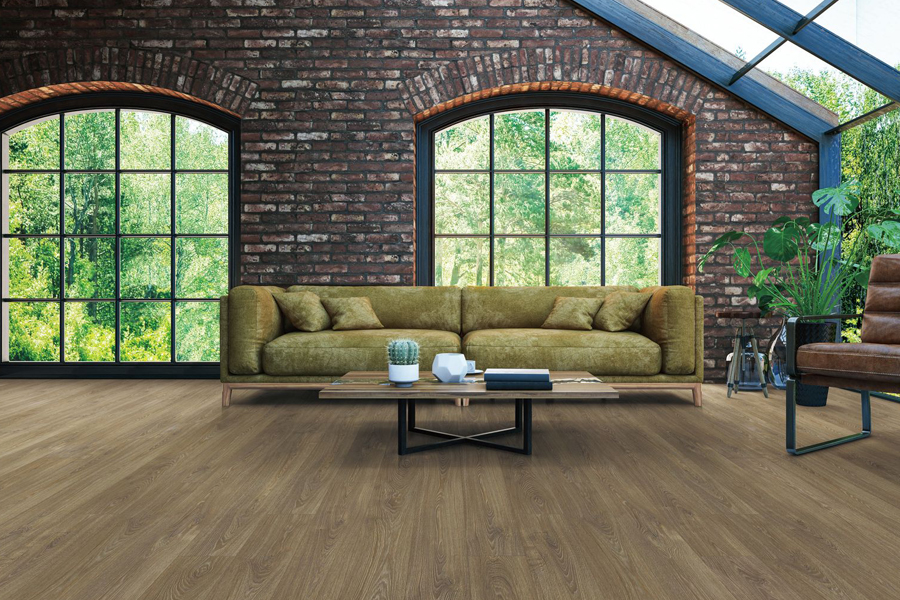
An AC rating tells you how much foot traffic a laminate floor's surface can take before it starts to wear, and for almost any home, an AC3 floor is more than enough. AC stands for Abrasion Class, and it's the durability number printed on the box or the spec sheet, running from AC1 up to AC5. The catch is that the AC number covers one thing only, which is surface wear, so a high rating tells you nothing about whether the floor shrugs off water, dents, or a dragged chair. Here's what each rating actually means, which one your rooms need, and the specs worth checking right alongside it.
What Is an AC Rating on Laminate Flooring?
An AC rating, short for Abrasion Class, measures how well a laminate floor's printed surface resists wearing away under foot traffic. Every laminate has a clear wear layer over a printed photo of wood or stone, and the rating measures how long that surface lasts before the print underneath starts to show through. The number comes from a European durability standard called EN 13329, which sets the AC scale, and from a bench test called the Taber abrasion test: a machine spins two abrasive wheels against a sample and counts how many cycles it survives before worn patches of about 0.6 square millimeters break through the surface. More cycles means a higher AC number. An AC1 floor has to reach at least 900 cycles, while an AC5 floor has to clear 6,500 cycles. That's the whole idea behind the rating, which is a wear-resistance score and nothing more.
What AC Rating Do You Need for Each Room?
For a house, an AC3 floor covers every room, and most residential laminate sold today is rated AC3 or AC4. The AC scale was built to cover both homes and busy commercial spaces, so the lower numbers are for light home use and the higher numbers are for stores and offices. AC3 sits right where a home needs it: it clears 2,500 abrasion cycles, which the standard rates for heavy domestic use, so it holds up in the busiest parts of a house, including entryways, kitchens, and hallways where grit gets tracked in. The table below shows the full scale, the EN 13329 use class that goes with each rating, and where it fits.
Rating | Min. abrasion cycles | EN 13329 use class | Built for | Where it fits |
|---|---|---|---|---|
AC1 | 900 | 21 (moderate domestic) | Moderate home use | Bedrooms, closets, low-traffic rooms |
AC2 | 1,800 | 22 (general domestic) | General home use | Living rooms, dining rooms |
AC3 | 2,500 | 23 (heavy domestic) | Heavy home use, light commercial | Any room in a house, including kitchens and entryways |
AC4 | 4,000 | 32 (general commercial) | General commercial | Offices and small shops; a durable pick for a rental |
AC5 | 6,500 | 33 (heavy commercial) | Heavy commercial | Stores and public buildings |
Reading down that table, the useful takeaway for a homeowner is that you rarely need to climb past AC3 or AC4. An AC3 floor is rated for the kind of traffic a family, a dog, and a front door put on a floor every day, and stepping up to AC4, at 4,000 cycles, buys a little extra margin for a mudroom, a busy rental, or a home-office chair on casters. You can see the range of ratings on the laminate we carry and match them to the rooms they're going in.
Is a Higher AC Rating Always Better?
A higher AC rating isn't automatically better for a home, because the top of the scale is built for traffic a house never sees. AC5 laminate is made for department stores and public lobbies, and some brands market an AC6 at 8,500 cycles or more for commercial and industrial floors, above where the EN 13329 standard even stops. Put one of those in a bedroom and you're paying for wear resistance that will outlast the house without ever being tested. That heavy-duty surface does nothing for the problems homeowners actually run into, like a spill sitting too long or a dropped pan, so the money is usually better spent on water resistance and a solid installation than on a commercial abrasion rating. Those top ratings earn their keep in the commercial spaces they were designed for.
What an AC Rating Doesn't Tell You
An AC rating measures surface wear and nothing else, so three things a homeowner cares about sit outside it entirely. It says nothing about water resistance: a laminate can carry a high AC number and still swell if water works into a seam, because that comes down to the core material and the edge treatment rather than the surface. Impact is a separate question too, since abrasion from foot traffic and the shock of a dropped cast-iron pan are different forces, and the AC test only covers the first. The locking system that holds the planks together isn't in the rating either, and on a cheap floor that's often what fails first. Even scratch resistance is its own property, distinct from the broad wear an AC number tracks. So if water resistance is your real priority, in a kitchen, a bathroom, or a basement, that's where luxury vinyl tends to pull ahead of laminate, because its core doesn't swell the way a laminate core can.
AC Ratings vs. NALFA Certification
In North America, a NALFA seal on the box tells you more than the AC number alone does. NALFA is the North American Laminate Flooring Association, the trade group whose certified seal is the closest thing the category has to an independent quality mark, and its ANSI-approved standard, LF-01, tests a laminate across 14 separate performance categories. Wear resistance, the one thing an AC rating covers, is only one of them. The others include impact, moisture and static load, staining, light and fading, and even castor-chair durability for a floor that will live under an office chair. NALFA also certifies floors by where they belong, from Residential up through Light Commercial, Commercial, and Heavy Commercial. So an AC number is a quick gauge of surface toughness, and a NALFA certification is the fuller picture; if two floors are both NALFA-certified for residential use, you can trust the surface either way and spend your attention on water resistance and the look.
Questions We Get About Laminate AC Ratings
What AC rating is best for a kitchen?
AC3 is the right rating for most kitchens, and AC4 is a sensible step up for a big, busy one. Kitchens see heavy foot traffic and tracked-in grit, which is exactly what the abrasion rating measures, so AC3 or higher handles the wear. The bigger question in a kitchen is water: look for a laminate with a water-resistant core and a tight edge treatment, or consider luxury vinyl, because the AC number by itself won't keep a spill from causing trouble.
Is AC4 or AC5 worth the extra money in a house?
AC4 can be worth a small premium in the busiest spots, but AC5 rarely is in a home. AC4 gives a little extra wear margin for a mudroom, an entry, or a rental between tenants. AC5 is built for commercial traffic, so in a house you're paying for durability the floor will never be asked to use. The exception is a specific floor you love that happens to be AC5, in which case the rating won't hurt anything; it just isn't worth chasing for its own sake.
Does a high AC rating mean the laminate is waterproof?
No. A high AC rating means the surface resists foot-traffic wear, and it says nothing about water. Water resistance in laminate comes from the core material and how tightly the planks seal at the edges and seams, which is a separate spec to ask about. If a room gets truly wet, a waterproof luxury vinyl is usually the safer call than any laminate, whatever its AC number.
What AC rating should laminate in a rental have?
AC4 is a smart rating for a rental, because it adds wear margin for tenant turnover without jumping to commercial pricing. Rentals take harder, less careful use than an owner-occupied home, and the extra abrasion resistance of AC4 buys some insurance between leases. Pairing it with a water-resistant core covers the two ways rental floors usually get wrecked, which are traffic and spills.
Will an AC4 floor still scratch?
Yes, because scratch resistance and abrasion resistance are two different things. The AC rating measures broad surface wear from foot traffic, while a scratch is a single gouge from a claw, a chair leg, or a piece of grit, and a floor can rate well on one and still show the other. Felt pads under furniture, a doormat at every entry, and prompt sweeping do more against scratches than chasing a higher AC number.
Matching the Rating to Your Rooms
The right AC rating is the one that matches how a room actually gets used, and for most homes that lands at AC3 or AC4 with a water-resistant core where it counts. That's an easy thing to sort out with samples in hand and someone who can tell you which floors are rated for what. When you're ready, request a free in-home estimate and our team will help you match the rating, the water resistance, and the look to each room, and measure while we're there. Joers Floors has helped Mishawaka and South Bend homeowners choose flooring for more than seventy years, and picking the right rating turns into a short conversation once you know what the number means.


